

Mitski // Puberty 2
| by Brandi Fullwood and Jeff Holland

[caption id=”attachment_18219”]

Mitski Miyawaki pictured above, photo by Ebru Yildiz[/caption]
Brandi: On a subway ride, the icy grasp of rejection, isolation and unrequited affection crawls over skin and pulls at tear ducts. There are too many people around for this to be a problem. At the core I become warm, my heart races past my panting and feels like it’s skipping. With only five people on the last car, I play “Once More to See You,” the third song off of Mitski’s latest album, Puberty 2, and begin to tear up. Pacing past loaded crowds and heaving loud sighs onto narrow passageways packed with tourists taking photos of anything, I realize then that I’m crying right in the middle of Times Square. Cliché. In the midst of delays and crowded streets, Puberty 2 allowed me to embrace the reality of frustration and alongside it. If you are upset, you don’t have to hold it in, you scream at it.
A couple of weeks pass and I sit crouched in the corner of the Bowery Ballroom, clinging to the balcony bars. I gaze down at Mitski and watch teardrops fall onto the people below me. Through blue misty lights they also appear to be crying. Mitski is in the middle of playing “Once More to See You,” her bass dragging against a haunting vocal, it all sounding pressed and hushed. In this song, Mitski explores the invasive nature of wanting someone: “And felt the taste of you bubble up inside me / But with everybody watching us / Our every move.” An important theme to note in Puberty 2 is the constant honesty. With songs like “Once More to See You,” listeners take on voyeurism and relate to her all at once. There is a comfort in this dismayed lullaby. She cradles us, but we are also pained by the idea of unrequited love in our own lives as much as hers.
Jeff: Equally relevant to the lives of Mitski’s listeners is the title and central theme of the album, Puberty 2. Mitski never released an album simply called Puberty. So there’s meaning attached to the number 2 in Puberty 2. Mitski is talking about a second puberty. When I was 13, I had an idealized image of my post-puberty self. My assumption was that, around age 18, I would stop changing, and I would finally be my stable, fully formed self. Of course that’s not true. I don’t think people become stable or fully formed at any point in their lives, let alone at 18. But especially in those late teens/early 20s years, there’s a different kind of growth going on, a different kind of puberty. You hear a lot of college students talk about looking for a major, a career, a partner, that makes them happy. But according to Mitski’s “Happy” (video embedded below; CW for gore), happiness is a double-crossing liar who will spend a night with you and then fuck you over, leaving you despondent again. I think a lot of us have a delusion that if we craft the perfect life for ourselves, maybe the pain will go away. Puberty 2 is the process of learning that the pain will never go away completely, and getting used to the perpetual waves of despair that define adult life.
[embed

would not have been able to explore this second wave of puberty that addresses rather than explains the themes of growth throughout adulthood.
Abrasive for some, the album is constantly a hub of boldness and maturity. It is harder to explain why you are hurting, much more than it is to proclaim you are upset. There is a detachment with sadness and expression: we are not meant to be expressive with our sadness, and if we are, we should talk to someone professionally. Public crying is shameful. Overly expressive Twitter accounts aren’t savvy. Self-deprecating humor is uncomfortable. Not only are other people afraid to know we are not okay, we are afraid to tell them ourselves.
Jeff: There is always a certain shame attached to “exposing” or revealing a part of yourself, but especially revealing sadness, depression, or any dark corner of the soul. Mitski touches on this idea in “Dan the Dancer,” describing a character, Dan, whose body is stretched and sapped of much of its physical strength “from leaning day to day / hanging onto a cliff.” In my mind I have a haunting, Tim Burton-esque image of a pale, sickly, long-limbed man. This Dan has a secret “bedroom dance routine” that he only shows to one person. These lyrics could be a metaphor for any number of things, but in my interpretation, Dan is depressed, and is “stretched” and weakened by his mental illness, and thus it takes him incredible effort to make a deep connection with another person (i.e. show them his true colors, his “bedroom dance routine”). The fast tempo and repetitive guitar pattern give this song an anxious feeling that compounds the unsettling effect of the lyrics.
Brandi: There are so many individual instances not explicitly told in this album that one could interpret as anxiety, simply through chord progression, pacing, and themes.
Moving on to discuss individual tracks:
Jeff: After a complex and effective build, “Your Best American Girl” cascades into an overwhelmingly powerful chorus, full of heavy distorted guitar and lo-fi vocals that sound like an avalanche hitting the microphone. And yet, for all this visceral, powerful rage, the lyrics are oddly subdued. It’s not your typical heartbreak song: it’s less of a plaintive wail and more of a resigned shrug. Mitski doesn’t need to infuse the lyrics with melodramatic cries of “Baby, come back” or “I need you,” because the emotional effect is already entirely achieved by the instrumentals. A line as innocuous as “I think I’ll regret this” becomes devastating when Mitski assaults your ears with her power chords and feedback.
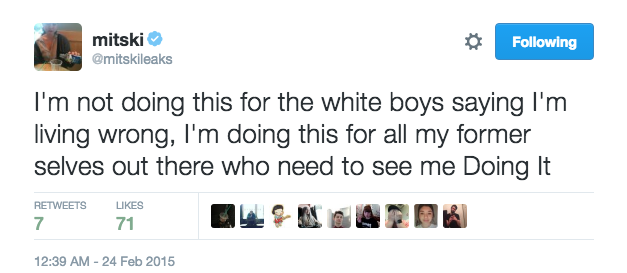
Brandi: One thing I’ve come to appreciate with this album—and Mitski in general—is that her songs are multi-dimensional in a way that I’m usually never able to relate to with a lot of indie rock. It is no secret that Mitski is in fact a woman of color and although one from a different background than my own, it means a lot to hear about heartbreak in a racial context. She presents the image of an outsider in a relationship with white men that is all the while familiar as much as it is seems customary.
”
Brandi: In contrast to the buildup and breakdown of “Your Best American Girl,” “Fireworks” instead remains static.
Jeff: The idea of numbness mirrors the static, unchanging, repetitive feel of the song. The feeling is tense, and the listener anticipates some sort of breakdown, but instead Mitski stays subdued and numb throughout the track. The closest we get to some emotional progression is when she raises her voice for the chorus: “And then one warm summer night / I’ll hear fireworks outside / And I’ll listen to the memories as they cry, cry, cry.” It sounds like she’s holding herself back to keep from crying herself. But it’s not her that’s crying: it’s the memories. It’s an internal pain that Mitski has stepped outside of, letting her emotions explode inside her uselessly, like fireworks.
Brandi: In the transition to summer, many of us are tasked with sorting through the residue of sadness and anxiety that comes with dreary winter. We enter a new sadness, a dwelling and comfort of past feelings. Some therapists call this a withdrawal from depression. When listening to “I Bet On Losing Dogs,” the compatibility in emotional state is eerie. The drawl of symphonic crying is a reminder of patterns of return, “I always want you when I’m finally fine,” she states. Coping comes easy, it is a matter of seeking out the best source for validation. “I Bet On Losing Dogs” takes into consideration the short and immediate happiness that comes with orgasm. Sex is not a tool for solution, but a way to feel content. If you swipe right and left enough times, you’ll start wonder if post-coital tristesse is really just a constant state. Mitski applies thrill and self-awareness to coping in this way, “how you’d be looking in my eyes when I cum - someone to watch me die.”
Jeff: There is a merge between orgasm and death, between sex and violence, within the paradigm of a relationship that is doomed to fail. Entering such a relationship is like betting on losing dogs—it’s knowingly setting yourself up for loss and disappointment. But there’s more here than just this simple metaphor: there is also the idea of feeling pity for the dogs, “looking in their eyes when they’re down.” If the dog represents a relationship doomed to fail, then Mitski pities both herself and her partner. The whole affair is a mistake that Mitski willingly makes. “I wanna feel it,” she moans. More than just a participant in an ill-conceived relationship, Mitski represents everyone who willingly makes poor decisions for temporary thrills. We all do it, and it brings us only misery.
Brandi: “A Loving Feeling” is a misleading sunshine, surf rock love song—that is not as romantic as anticipated. foot-popping kiss.
And yet, it’s not that at all. In truth, instead of it being the love you’ve always wanted, Mitski details it in a take what you can get kind of attitude with uplifting regret. The song is mocking and reminds me of the ideas of relationships that


and

built for me—absolute consumable B.S. (that I definitely still watch). “What do you do if they only love you when you’re all alone?” She reveals the fabrication of intimacy and affection (this song may have been written for me and that’s totally fine with me), showing it no mercy for its misleading character.
Jeff: Surf rock and pop songs alike talk about love and sex as if it’s fun, easy, and pleasant.
Brandi: It is the pornography of love songs—no condom scene, complete confidence, and no questioning.
Jeff: Mitski plays with these tropes sardonically: “Making love to other people / Telling each other it’s all good.” And then there’s the line, “Kisses like pink cotton candy.” Cotton candy is a fluffy, vaporous, unhealthy substance that melts easily and turns you into a sticky mess. A kiss that is “like cotton candy” is not a meaningful or healthy kiss; it’s a temptation that should be avoided.
[bandcamp width=400 height=472 album=2642707299 size=large bgcol=ffffff linkcol=e99708 artwork=small]
Brandi: Let’s be honest. When I listen to Mitski I like to confirm and maintain that everything around me feels like it’s falling apart. Somehow she manages to make that moment feel important. Puberty 2 is a strong source of validation, that the way I’m feeling is real and it’s okay to feel that way. There is no need to cover it up as overthinking or being scatter brained. With just the right headphones, the subtle scuzzy noise of the album fills my ears and intertwines throughout my body, building up tension and the confidence to text everyone in the world about how I’m feeling and ask how they may feel about me. There is enough to explore in terms of Mitski’s artistic ability, the craft of putting this album together is certainly a nod toward her creative range and confidence in public emotional display. There is also a lot to be said for her impact on listeners, very few take ownership of themes of death, love, sex, self pity, or lust and deliver it in a package of their own. There is something truly telling of her raw delivery—it is a string of poetic thought.
Jeff: Mitski is there for you at all of your emotional extremes. She’s there when you feel unloved, and when you’re sick of love. and when love turns into heartbreak. And she knows that the exhilarating high of new romance is too tempting to resist. She empathizes when you hate yourself, and she’s with you every step of the way when you’re trying to love yourself again. She knows what it feels like to be a hopeless, depressive mess. She’s the friend who tells you that your sadness is valid.
Brandi: they humanize you.
No tears were hurt in the making of this review.
BEST TRACKS: 5, 1, 4, 3, 7, 11, 8
RIYL: St. Vincent, Frankie Cosmos, Angel Olsen, Hop Along
GRADE: A-
Spotify.
beefing with Ezra Koenig of Vampire Weekend. She will be General Manager in the upcoming year.