

The Avalanches // Wildflower
| by Jeff Holland
Music, Electronic, Hip Hop, Album Review, Pop, Rap
[caption id=”attachment_18370”]
The Avalanches, L to R: Tony di Blasi, Robbie Chater, James dela Cruz.[/caption]
, directed by John Waters. Waters is a master of gross, bizarre, dark comedy, typically taking aim at the depraved denizens of white, suburban, upper-class America. In this particular film, an unfortunate housewife named Francine Fishpaw (played by the outrageous drag queen Divine) receives a phone call from the principal of her son’s school, part of which proceeds as follows:
PRINCIPAL KIRK: Is Dexter ill today?
MRS. FISHPAW: No, Mr. Kirk, Dexter’s in school!
MR. KIRK: I’m afraid he’s not, Mrs. Fishpaw. Dexter’s truancy problem is way out of hand. The Baltimore County School Board has decided to expel Dexter from the entire public school system.
MRS. FISHPAW: Why, Mr. Kirk, I’m as upset as you are to learn of Dexter’s truancy, but surely expulsion is not the answer!
MR. KIRK: I’m afraid expulsion is the only answer.
At this point, I had to pause the film, because all of our jaws had just dropped. We had all heard this conversation countless times before, but we knew it only as the introduction to the Avalanches’ classic sample-based ode to criminal insanity, “Frontier Psychiatrist.” Before we could continue watching, we all needed to take a few minutes to calm down and stop laughing.
.
still sound fresh and relevant in the vastly different cultural milieu of 2016.
mirrors its predecessor in style, structure, and feel. Both albums take the form of a cinematic journey (or “road trip”), with an abundance of short tracks that all flow into one another like a woven tapestry, forming an album that feels like a cohesive work of art, but also has a charming sense of homemade spontaneity. Both albums are full of a sense of wonderment and joy, as well as a silly sense of humor, but also subtle undertones of nostalgia and even sadness. Both albums are meticulously crafted and contain enough subtlety and complexity to deserve numerous repeated listens.
’s “My Favorite Things” unexpectedly flows in, another example of the Avalanches’ charming spontaneity as well as the recontextualization of a well-known melody.
[embed

sung by a kid from the New York City projects in 1959, while Bronx rap duo Camp Lo provide the verses. The authentic NYC vibe comes through strongly. The same is true of “Subways,” which samples a 1980 post-punk

of the same name by 12-year-old singer Chandra—also from New York, of course. These urban-flavored tracks illustrate how sample-based music can transcend geographical and cultural boundaries: theoretically, a group of Australian DJs should have no business making music that sounds like New York City. But, by using samples and guest rappers, they shine a spotlight on the authentic voices who actually do come from the city, while also infusing the song with a newcomer’s sense of curiosity and awe. Both songs make you feel like you’re visiting the city for the first time, feeling your heart pound with excitement as you walk the busy streets and navigate the subway. Even a seasoned New Yorker could understand that feeling.
[embed
, still my favorite song by them). At the end of that track, we hear the sound of the tide rolling in, a woman exclaiming “Isn’t it great!”, and a young man saying, “Come on, I know a spot where we can go.” You can just feel the youthful West Coast excitement. We don’t know exactly what these characters are so excited about, which makes it all the more fun to imagine.
[embed
-era Beatles and jaunty carnival music, in which Pink sounds right at home—and meanwhile, rapper Paris Pershun provides bouncy but politically charged verses: “They say I’m a thief/They callin’ me thug/They say I’m a killer/I just say what’s up?” The samples of cops at the end of the song continue the unexpected political commentary: “License and registration, please?” says a white cop, and then we hear distinctly black voices murmuring anxiously. Some might argue that a fun, joyous, psychedelic album is not the place for political commentary; and yet, on an album that’s largely about people from all different backgrounds coming together to have fun, it does feel appropriate to acknowledge the fact that our society doesn’t afford the same having-fun privileges to people of color that it does to white people.
in a way that gives impressions of disillusionment. Over a hip-hop beat, creepy high-pitched voices repeat: “There is magic in the splendor and desire to surrender.” In the middle, the beat is compressed and a soft voice murmurs: “I have been over the rainbow/And I found nothing there/But very thin air.” The dreamy darkness gives way only in the second half of the song, in which Danny Brown comes back for his second appearance, rapping over soothing acoustic guitars.
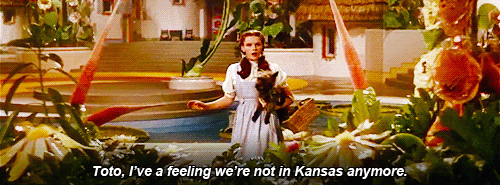
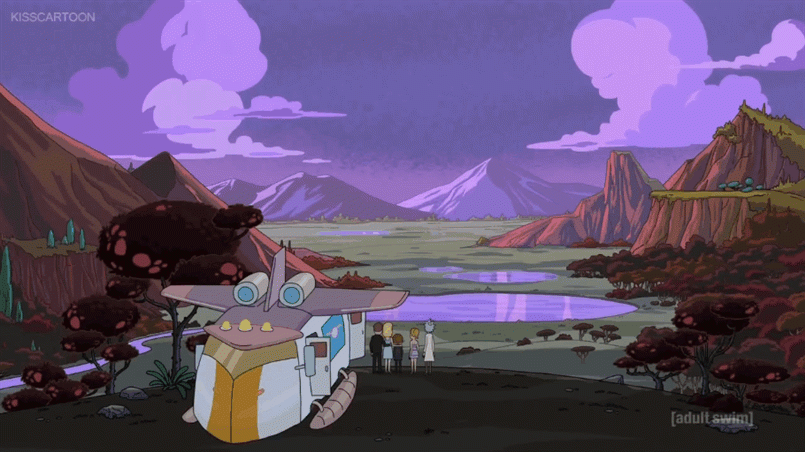
Dark undertones also play a role on the next track, “Sunshine,” in which a glimmering pop chorus is chopped up over a hip-hop beat. The glitchy, repetitive production gives hints that there’s more going on here than just sunshine and happiness. It still sounds ostensibly happy, but the lyrics are about lost love: “Then you went away/Turning my blue skies gray/And taking my sunshine.” The strings at the end create a sad, nostalgic feeling, as if the road trip is coming to the end and you have a bittersweet feeling in your stomach as you drive homeward, watching the sun sink into the horizon.
[caption id=”“]
I fell in love for sunshine.[/caption]
Still, the album concludes on a happy note, with indie guest stars who usually deal in cynicism sounding unusually optimistic with the Avalanches by their side. On the penultimate track, “Stepkids,” Jennifer Herrema of Royal Trux sings lyrics full of punk-teen nostalgia: “Light firecrackers while we crack cans of beer/And if those boys ain’t skating there/Maybe we can paint pentagrams and pot leaves along the walls.” Finally, Father John Misty gives subtle, angelic background vocals to lo-fi disco closer “Saturday Night Inside Out,” while Silver Jews’ David Berman speaks lines of his own poetry: “I adored the way she modified my mornings/When I’d wake up in the calm shoals of her bed.” It’s a beautiful conclusion to a beautiful album.
If I have one complaint about this album, it’s not with the Avalanches themselves, but with one of their guest stars: the rapper Biz Markie, who makes his appearance on “The Noisy Eater.” Over a sample-heavy background that includes the sounds of his own munching noises, the “Clown Prince of Hip-Hop” gives a silly, cartoonish rap about eating cereal for breakfast and salmon for lunch. The whole track is very Avalanches-style goofy, but Biz Markie’s sense of humor falls flat for me. The intoxicated listener might get a kick out of it, and anyone can appreciate the way the Avalanches cleverly appropriate a children’s choir’s take on the Beatles’ “Come Together” for the chorus, but I personally have to grimace and hold my breath until Markie finally finishes his weird, awkward ode to mealtime.
, but if the next generation of sample-based musicians can learn from these Australian maestros, then the future looks bright.
BEST TRACKS: 2, 3, 4, 6, 7, 12, 15, 21
RIYL: Danny Brown, MF Doom, Toro y Moi, Mercury Rev
GRADE: A-
Wildflower was released July 8 on XL Recordings. You can download it from iTunes or stream it on Apple Music.
Jeff Holland is a rising sophomore. This summer, he hosts “Purge Ur Demons,” a show for dark music, as well as “Summer AESTHETIC,” a show for vaporwave. He will be music director in spring 2017 along with Maddy Goodhart.
